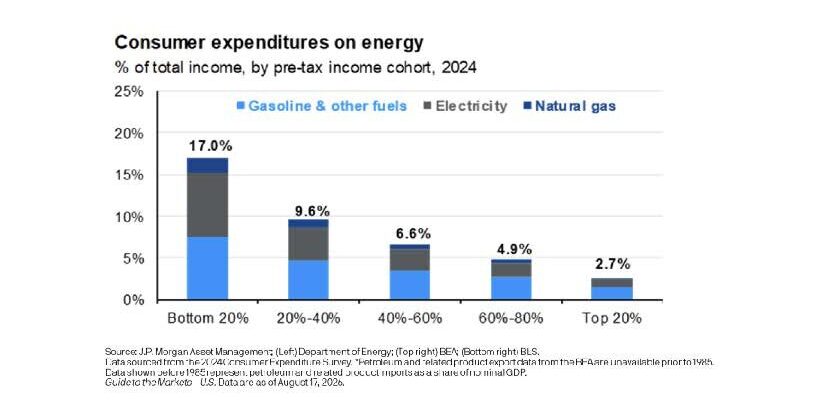
The chart of the week shows that energy expenditures take up a much larger share of income for lower-income households than for higher-income households. This is a topic we discuss often, and while the price of oil has been a strong predictor of short-term stock market returns, particularly since the conflict in Iran began, the impact of energy prices extends well beyond financial markets.
The bottom 20% of earners spend about 17% of their total income on energy, compared with just 2.7% for the top 20%. This means that energy costs place a much heavier financial burden on lower-income households. Larger increases in energy prices can be especially damaging to these families because they already devote a significant portion of their income to energy, and there is only so much money to go around, particularly if these households have less capacity to save and thus use savings to fill the gap.
A sharp increase in energy prices, somewhat that is out of consumers hands, can force lower-income families to cut back on other necessities, such as food, transportation, or housing. Overall, large increases in energy prices can have a disproportionate impact on lower-income households because they have less income available to absorb higher costs.